
19.05.2026
Uncategorized
“The Russians are significantly lagging behind’: German outlet Welt reports on the technological solutions of MAC HUB
On the banks of the Dnipro River, specialists from Military Armored Company HUB are demonstrating their own developments to foreign journalists. On the water, the Katran X1.2 naval drone and the MAC Dead Fly interceptor operate as a single coordinated system; however, in reality, the engineers are showcasing much more – the subtle, at first glance almost invisible, yet complex and highly technological work of the MAC Construct team.
“Ukraine is defending itself against Russian aggression using innovative unmanned systems and other weapons systems, and this strategy is currently working so well that some are already talking about a ‘turning point’ in the war,” writes German journalist Alfred Hackensberger in a Welt publication.
At present, Ukraine is confidently developing its military technologies and establishing itself among global industry leaders, although not long ago it was primarily receiving assistance from Western partners. The situation has changed so rapidly that technological solutions developed by Ukrainian defense companies are attracting sustained interest abroad, including in Middle Eastern countries.
MAC HUB specialists do not merely produce modern weaponry – on the fifth year of the full-scale war, this is no longer something new for the Armed Forces of Ukraine. Today, the company’s engineers, together with experienced military personnel, are developing and refining an innovative operational control system, MAC Mission Control.
It is designed to plan complex, multi-layered missions using any of MAC HUB’s unmanned systems on water, on land, and in the air. In essence, it unites all combat platforms into a single network and provides centralized coordination of operations in real time. MAC Mission Control is also integrated with the Delta situational awareness military system.
“The combination of unmanned vessels and interceptor drones is a technological and tactical innovation in the history of modern warfare. It adds another layer to Ukraine’s multi-tier air defense and simultaneously opens new opportunities in naval warfare. First, drones strike enemy radar systems, and then unmanned boats can target oil platforms and naval vessels,” the German publication emphasizes.
Today, many Ukrainian companies are working on similar projects. This creates a highly competitive market and contributes to improving product quality; however, a crucial element of this workflow is high-quality and timely feedback from the military. That is why MAC Construct engineers develop all solutions in close cooperation with special forces from the ‘Black Sea Legion’ unit. These are people who carry out the most complex and usually classified missions. “The Legion usually stays in the shadows. Welt received a rare and exclusive opportunity to observe their work,” writes Alfred Hackensberger.
It is precisely this dialogue that makes MAC Construct’s products unique, as the company works not only for the military but together with them. “A year ago, none of this would have been possible,” says the commander of the naval unit of the ‘Black Sea Legion’ (part of the active operations unit of the Defence Intelligence of Ukraine, HUR, FERRATA). For security reasons, he gives journalists only his callsign – “Ninth”. He is the person who tests MAC HUB’s products in real combat conditions, and according to him, this is why the company is developing so rapidly. “Direct exchange between the manufacturer and the military significantly accelerates development and improves product quality,” emphasizes “Ninth”.
Meanwhile, the Katran X1.2 unmanned surface vessel heads out onto the water. This is far from a new development for MAC HUB, as the naval drone has already taken part in successful operations (including the operation to regain control over the “Boyko Towers”) and has secured its place in the history of modern warfare. Katran is nine meters long, powered by a 350-horsepower engine, capable of traveling up to 1,600 kilometers, and can also function as a kamikaze drone. However, first and foremost, Katran was designed as a multi-purpose transport platform. This USV can carry two short-range R-73 missiles (capable of shooting down helicopters and fighter jets) as well as various drones. The configuration of Katran’s drone payload is left to the military, as they plan every operation down to the smallest detail.
This time, the payload includes 27 MAC Dead Fly interceptors. These are modern, relatively simple to manufacture and operate, yet fast and effective interceptors with integrated AI. They can autonomously locate targets and reach speeds of up to 380 kilometers per hour. This is sufficient to destroy Shahed drones. However, engineers are already working on a new request from the military: increasing the speed to 450 km/h.
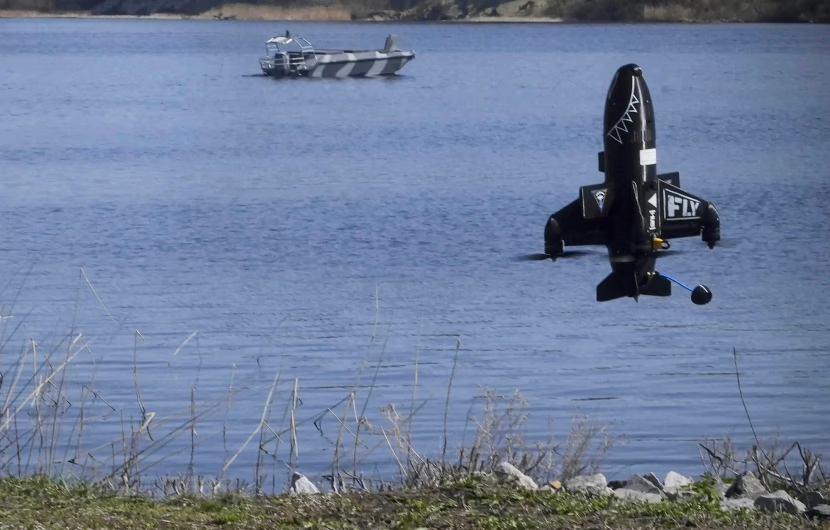
Launch of the MAC Dead Fly from the Katran X1.2 USV / Photo by Welt
“Both the naval drone and the interceptors are controlled from a mobile tent on the shore. The pilot wears special goggles and uses a remote control, while the boat operator uses a joystick. What looks like a gaming chair is actually a specially designed high-tech solution,” writes Welt.
Such a mobile command center can carry out combat missions from anywhere in Ukraine, as long as there is access to the MAC Mission Control system. It is designed as a unified platform for executing and planning the most complex missions. Engineers have maximized the use of AI for instant calculations, system synchronization, mission archiving, and forecasting, while keeping all decision-making in human hands.
In Kyiv, German journalists are shown the company’s large MAC HUB office. It is there, writes Alfred Hackensberger, that all of its technological solutions are born and refined: “Dozens of employees sit attentively in front of computer screens. They train artificial intelligence systems, calculate weather conditions and sea state, and plan routes. Others practice as boat pilots on simulators or monitor real-time video feeds. In another department, new drones are being designed on screens, from the fuselage down to the smallest screw. Here, in this engineering hub, Ukraine is developing the strategy with which it intends to liberate its land.”